 Matter Metals The Second Main Group - Alkaline-Earth Metals

| You are viewing text created during the EU sponsored project "Kids & Science". More information on this project can be found on the project Web site: www.kidsandscience.org |
| Kids&Science Matter Metals The Second Main Group - Alkaline-Earth Metals |
|
| See also: The First Main Group - Alkali Metals, The Bleaching Effect of Chlorine, Sodium, Potassium - Experiments | |
The Second Main Group - Alkaline-Earth MetalsThe Alkaline-Earth Metals Beryllium, Magnesium, Calcium, Strontium and Barium are very reactive and therefore they only exist as compounds with other elements in nature. The alkaline-earth metals are light metals. BerylliumWas named after the mineral beryl, in which it was found for the first time in 1798. It forms very elastic alloys and for that reason, it is used for the production of gears, springs and other parts of machinery. Beryllium is also used for parts in rocket propulsions, because it has a very high melting point at 1283°C. MagnesiumWas named after Magnesia, an old town in Asia Minor. It was discovered in 1775 and belongs to the ten most common elements.
Magnesium burns with a bright white flame and reaches temperatures up to 2500°C. Burning magnesium cannot be extinguished with water! Magnesium also burns in other gases, which contain chemically bound oxygen like carbon dioxide or sulphur dioxide. Because of these properties, magnesium torches burn under water as well and can be used as underwater lights for diving. Magnesium is valued in the production of aeroplanes and engines as it is a very light alloy component. Engines of cars contain about 20% magnesium. NASA used an alloy of 84.75% magnesium, 14% lithium and 1.25% aluminium for the Saturn-V rocket. From time to time, this light metal can also be found in objects of daily life like pencil sharpeners. Purified, aqueous magnesium silicate - called talcum - is used in the cosmetic industry as a basis for toilet powders and make-ups because of its neutral and non-irritating properties. The human body needs magnesium, too. A lack of magnesium may cause muscle cramps and increased nervousness. So-called bitter mineral water is mineral water that contains magnesium sulphate. Calcium, Strontium and Barium are silver-white and get dim when exposed to the air. They are very soft. CalciumIs derived from calx, the name for lime - a calcium oxide. It was discovered in 1898. Calcium is the 5th most frequent element in the earth’s crust. It is an essential element. The human body normally contains about 1.5 kg calcium, mainly in the bones and teeth. The heartbeat is controlled by calcium, too. Plaster - also used for broken bones - consists of calcium, sulphur and oxygen (CaSO4 x 2H2O). Marble and chalk are made of calcium carbonate (CaCO3). StrontiumIs derived from Strontian, Scotland and was discovered in 1790. It is a rare metal and kind of an antagonist to calcium, which is so vital. Radioactive strontium occurs in atomic dust. It can be incorporated into the bony tissue instead of calcium, destroying bone marrow and causing leukaemia as a result. Non-radioactive strontium compounds are used for fireworks to create luminous red flames (Bengali fires) and for the production of luminous paint. BariumFrom barys, which means heavy, or dense. It was discovered in 1808. Barium sulphate, a white substance, is used as a contrast medium in medicine. When ingested, the stomach and the intestine become visible in x-ray examinations. It is also used for the production of white paint and serves as an agent in the production of very fine types of paper. Barium colours flames green. |
| Material courtesy of Kids&Science Foundation |
Web space and technical support provided by Epina GmbH |
Last Update: 2004-Feb-29 |
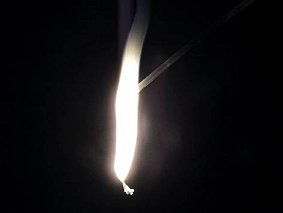 It is a silvery metal that can be worked very easily. Magnesium has a relatively low melting and boiling point.