 Air Wind and Weather Wind Special Winds

| You are viewing text created during the EU sponsored project "Kids & Science". More information on this project can be found on the project Web site: www.kidsandscience.org |
| Kids&Science Air Wind and Weather Wind Special Winds |
|
| See also: No Rain Without Sunshine!, Fog and Clouds, Clouds | |
Special WindsWhat Is a Hurricane?
What Is a Tornado?
Origin:
Normally, the warm air rises like a balloon, cools down during that ascension and forms water droplets, which fall to the ground as rain. If a crosswind occurs in addition to these extreme differences between cold and warm air, which deflects the ascending warm air to the side, this warm air starts to rotate around its own axis with high speed. The vortex gets faster and faster and narrower and narrower – like a skater who rotates faster, when he/she puts his/her arms to his/her side. |
| Material courtesy of Kids&Science Foundation |
Web space and technical support provided by Epina GmbH |
Last Update: 2004-Feb-29 |
 Hurricanes are gigantic cyclones, which can cause a lot of damage due to their size. They can have a diameter of more than 500 km. The centre of the hurricane, the eye, where it is almost still, has a diameter between 15 and 30 km.
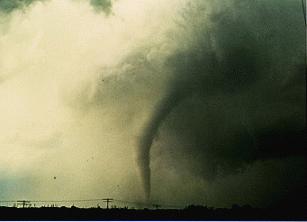 A tornado is a hose-shaped cyclone. It is smaller than the hurricane, but still has devastating effects. Usually it occurs in conjunction with thunderstorms, like the hurricane, especially in the Midwest of the United States. Its diameter is between 10 and 100 metres. The speed of the originating up-currents in the hose reaches up to 600 km/h.