Diet Alcohol and Drugs Alcohol Alcoholic Beverages

| You are viewing text created during the EU sponsored project "Kids & Science". More information on this project can be found on the project Web site: www.kidsandscience.org |
| Kids&Science Diet Alcohol and Drugs Alcohol Alcoholic Beverages |
|
| See also: Smoking, Poll About the Topic of Alcohol, Risks of Alcohol | |
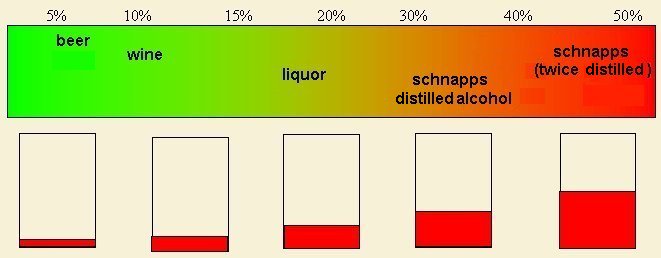
Alcoholic BeveragesHow is Alcohol Produced?Alcohol is produced when sugary liquids are mixed with yeast and left in the warmth. After a few hours, the mixture starts to bubble and alcohol is made. This is called fermentation. Over time, the yeast cells have produced so much alcohol that they start to die of it. Therefore, only beverages with an alcohol content of about 16% can be made this way. In order to get 'stronger' alcoholic beverages or pure alcohol, the liquids have to be distilled. Since alcohol evaporates more easily than water (i.e. at lower temperatures), it can be separated by heating the liquid and collecting the vapours. Alcoholic beverages are classified according to their alcohol content:
How does Alcohol Work?Alcohol is a powerful cell toxin (and can be used as a disinfectant for that reason). As a result, it has a negative effect on human perception. The ability to concentrate and think logically diminishes, the field of vision becomes smaller and reflexes slow down. These are only a few of the reasons why you are not allowed to drive when you are drunk. It is possible to use exhaled air to measure the alcohol content in the body. This method is used at road checks. Here you have to breathe into a small tube, which changes its colour if alcohol is present.
|
| Material courtesy of Kids&Science Foundation |
Web space and technical support provided by Epina GmbH |
Last Update: 2004-Feb-29 |